
Wine, Spirits & Gift Sets
Wine Glass Buying Guide: Profiles & Wholesale Specs
Compare wine-glass profiles, capacity conventions, dimensions, materials, decoration and packing before approving a wholesale stemware order.
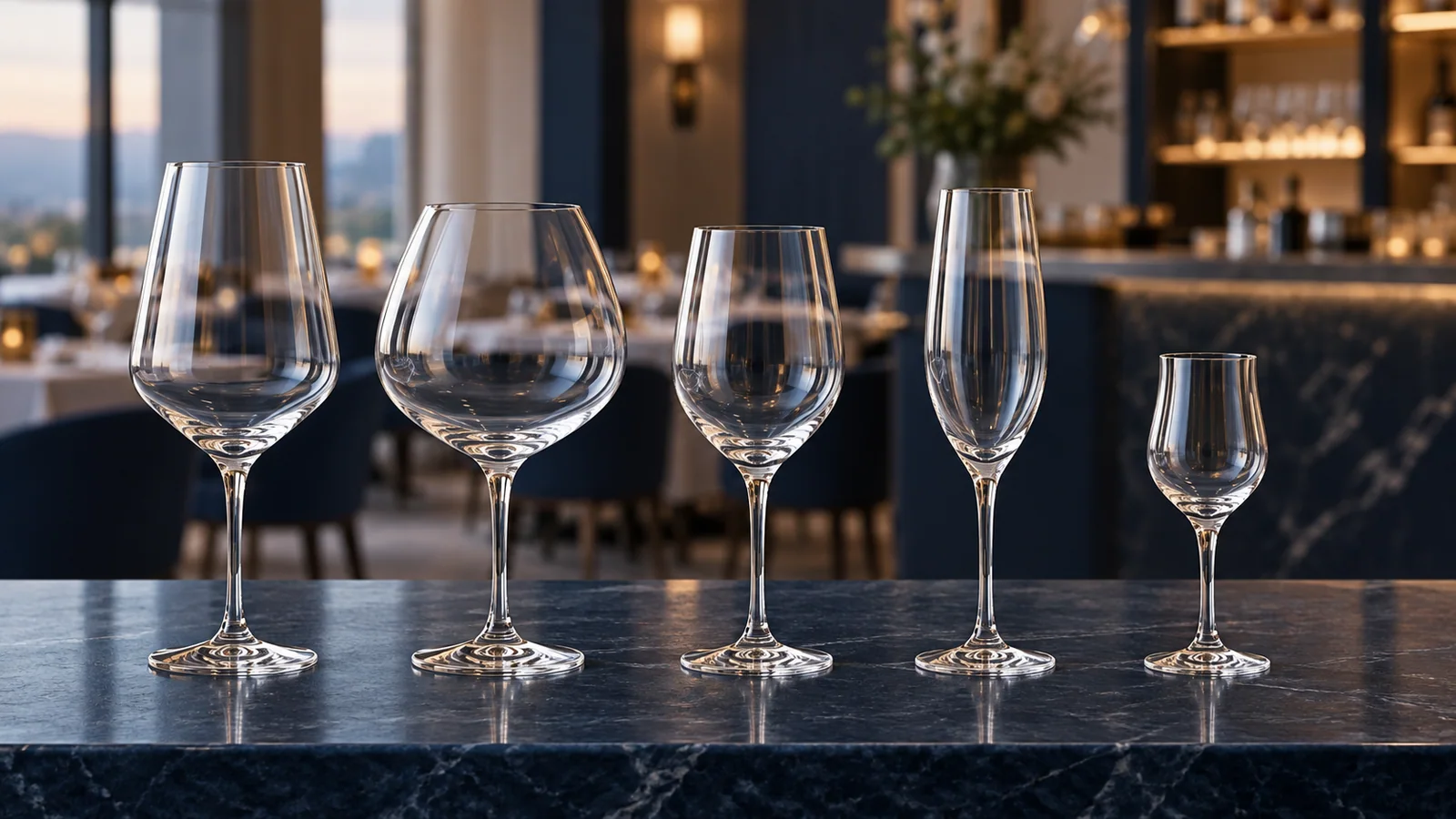
A wine-glass quotation is only comparable when every supplier is pricing the same finished item: the same profile, capacity convention, dimensions, material description, decoration, packing and sample requirements. A familiar name such as “Bordeaux glass” or “lead-free crystal” is not a complete specification.
This guide shows hospitality buyers, distributors and retailers how to turn a menu or assortment plan into a stemware brief that can be measured and approved. It does not assign universal capacities, tolerances, serving sizes or compliance documents; those decisions depend on the destination market, channel, intended use and exact product.
Quick answer: specify the service before the glass
Start with four decisions:
- Use: restaurant service, banquet, hotel room, tasting, retail or gift set.
- Drink and fill: wine style, intended serving volume, required headspace and any marked-measure requirement.
- Operating environment: tray, rack, shelf, wash process, polishing and storage constraints.
- Commercial scope: quantity by SKU, decoration, packaging, replacement plan and destination market.
Then shortlist one or more profiles and confirm them with a drawing or physical sample. Capacity alone cannot tell a buyer how much shelf space a glass uses, whether it fits a dishwasher rack or how it feels in service.
1. Translate the menu into glass roles
Wine-glass names are useful search labels, but they are not standardized engineering drawings. Suppliers may use the same profile name for different shapes and capacities. Describe the silhouette and intended role, then attach dimensions or a reference sample.
Tall tapered red-wine profile
This format has a relatively tall bowl and an opening narrower than its maximum bowl diameter. It can be considered when a restaurant wants a distinct red-wine presentation. Procurement checks should focus on finished drink volume, bowl diameter, overall height, rack fit and stability—not a claim that one shape is universally correct for a grape variety.
Wide balloon profile
A wide rounded bowl creates a visibly different presentation and uses more tray, rack and carton space. Confirm the maximum diameter as well as the rim diameter. If the glass will be used at banquets or on crowded tables, test its footprint and handling with the actual service setup.
All-purpose profile
An all-purpose glass can reduce the number of operational SKUs when one profile works for several wines and service occasions. Compare it with the largest planned pour, required headspace and the venue’s red- and white-wine presentation. “Universal” remains a buyer-approved role, not a product performance guarantee.
Champagne flute or tulip profile
Flutes and tulip-shaped glasses are both used for sparkling-wine service, but their bowl width, opening and height differ. Specify the selected silhouette and test it with the intended fill, tray and rack. Do not assume the words “champagne glass” define one capacity or shape.
Small dessert or fortified-wine profile
This is normally a smaller stemmed format, but the required serving volume and any legal measure depend on the destination. In Great Britain, for example, the government lists 50 mL and 70 mL measures for port, sherry and other fortified wine sold by the glass. That rule should not be presented as a global standard. See the UK specified-quantity guidance.
2. Separate brimful capacity from the intended fill
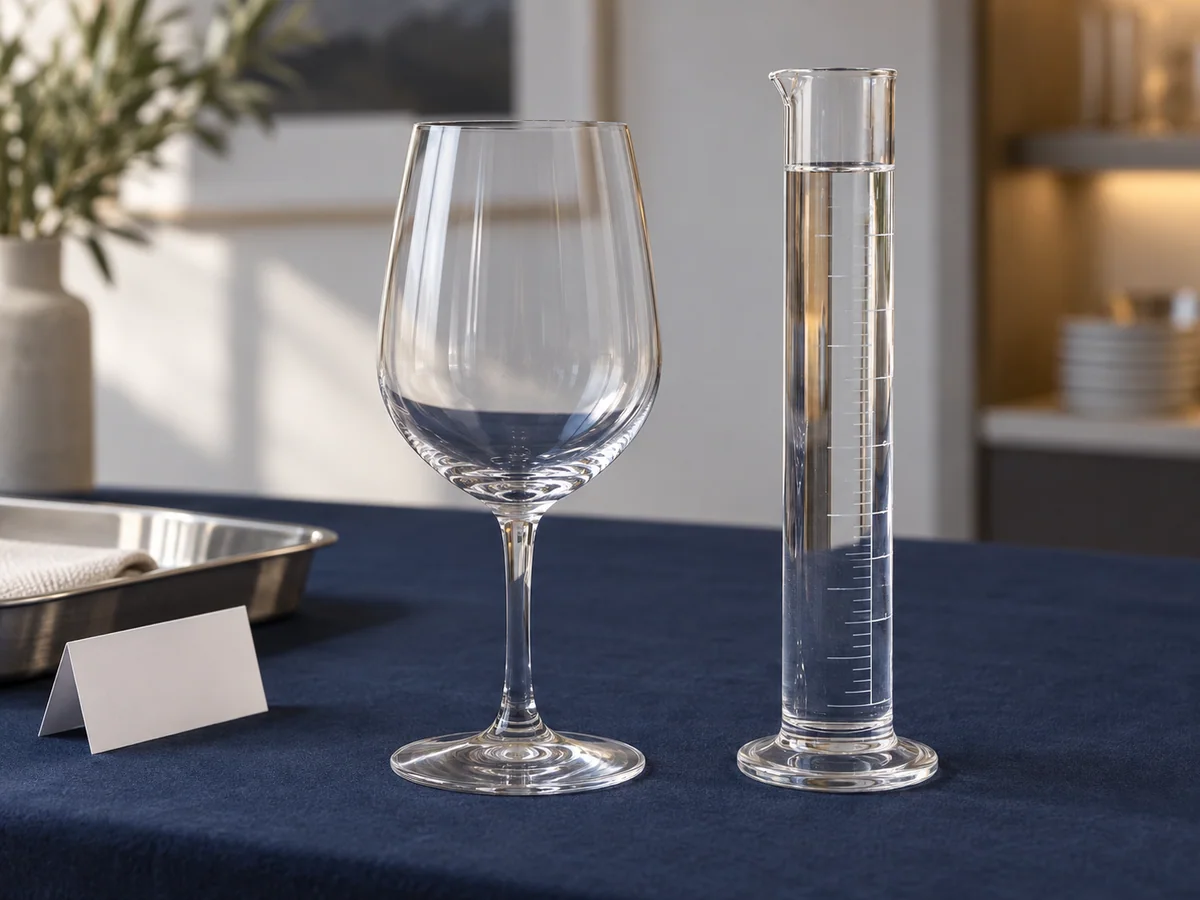
Record the capacity convention instead of writing a bare number:
- Brimful capacity: the volume held to the rim using an agreed measurement method.
- Nominal capacity: the supplier’s declared size or model designation; ask how it was determined.
- Intended fill: the volume the buyer plans to serve or display in the glass.
- Marked measure: a line or capacity indication that may require destination-specific verification.
There is no reliable universal rule that intended fill must equal 60%–70% of brimful capacity. The usable relationship changes with bowl geometry, wine, service style and presentation. Test the intended fill in the exact sample and photograph the approved level.
Serving references also vary by purpose and market. The US National Institute on Alcohol Abuse and Alcoholism uses 5 US fl oz of 12% table wine as one US standard-drink example, while explicitly noting that standard-drink amounts may not reflect customary serving sizes. In Great Britain, still wine sold by the glass is listed in 125 mL, 175 mL or multiples of those measures. These are different frameworks, not one global purchasing rule. See NIAAA’s standard-drink explanation and the UK specified-quantity guidance.
If quotations use fluid ounces, state whether they are US or Imperial fluid ounces and keep milliliters as the comparison unit. A conversion does not prove the measured capacity of a particular glass.
3. Put dimensions and tolerances on a drawing
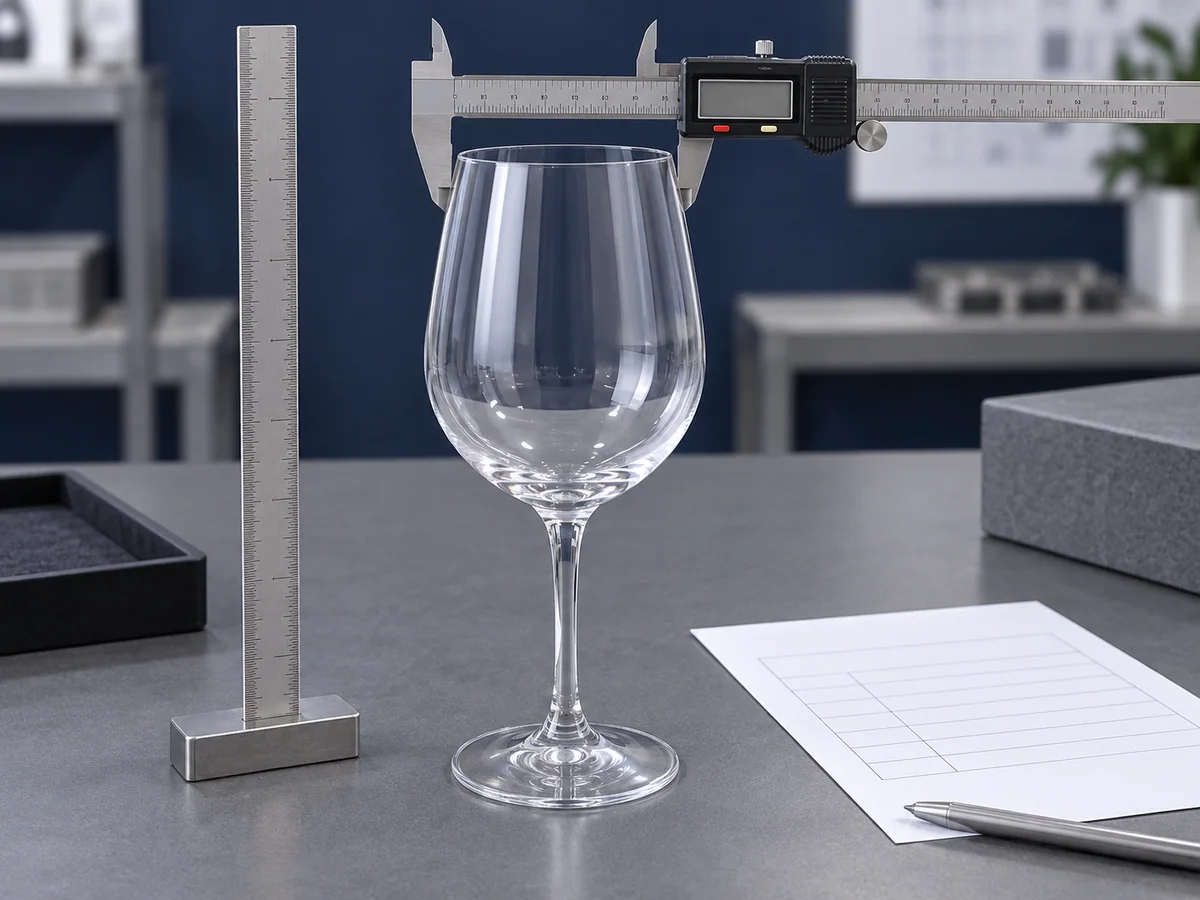
Ask for a dimensioned product drawing and record at least:
- overall height from the bottom of the foot to the rim;
- maximum outside bowl diameter and where it occurs;
- inside and outside rim diameter if both matter to the use;
- bowl height and the point where the bowl meets the stem;
- stem height and stem diameter at an identified measurement point;
- outside foot diameter and base flatness requirement;
- unit weight and the agreed weighing condition;
- brimful capacity and the agreed measurement method.
Add functional clearances from the buyer’s operation: rack compartment, shelf height, tray footprint, cabinet or gift-box insert. These checks often matter more than the catalog name.
Do not copy a universal capacity or dimensional tolerance into the purchase order. Tolerances depend on forming process, design, measurement method and supplier capability. Ask the supplier to state achievable production tolerances, then approve them on the drawing and sample. A nominal dimension without an agreed tolerance is incomplete.
4. Treat material and performance as separate claims
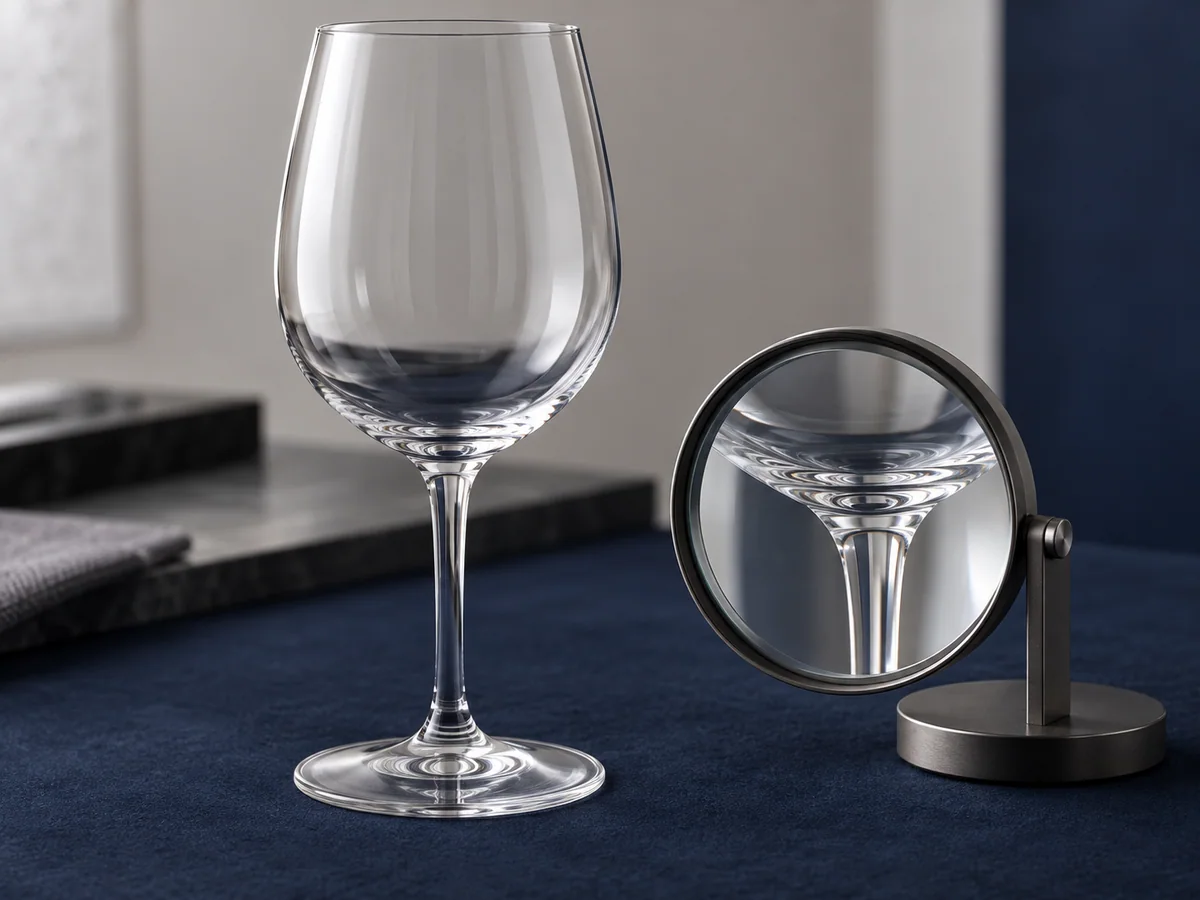
Ask the supplier to identify the glass composition or commercial material description, forming method and any strengthening process. Then request separate evidence for claims such as dishwasher suitability, thermal-shock resistance, mechanical strength or a particular crystal-glass designation.
Do not rank soda-lime glass, “lead-free crystal,” tempered glass and lead crystal with a generic good/better/best table. Clarity, weight, strength, break pattern, care and price depend on the formulation, design and process of the exact item. A thick-looking stem does not prove durability, and a bright appearance does not establish composition.
“Crystal glass” terminology can also be market-specific. The EU has controlled descriptions and composition or property criteria under Council Directive 69/493/EEC. Do not define “lead-free crystal” with one unsupported global percentage; request the supplier’s composition declaration and the documents required for the destination market.
For EU food-contact use, the European Commission states that food-contact materials, including glass tableware, fall under the general framework of Regulation (EC) No 1935/2004, alongside applicable good-manufacturing and national requirements. The relevant evidence depends on the finished product and destination. See the European Commission food-contact-materials overview.
For US-bound decorated glass or lead-crystal products, request evidence relevant to the finished food-contact surface rather than using a generic “FDA” logo. The FDA publishes a laboratory method covering extracted lead and cadmium from decorated glass and lead crystal; a test method is not itself a blanket product approval. See FDA EAM Method 4.6.
5. Specify decoration on the finished glass
Separate the blank glass from the decoration requirement. Record:
- process proposed by the supplier;
- artwork dimensions, position, orientation and color reference;
- whether artwork aligns to a seam, logo position or opposite-side mark;
- contact restrictions near the rim or food-contact surface where applicable;
- finished-product care instructions and wash conditions;
- proof, pre-production sample and approval sequence;
- packaging protection against rubbing or scratching.
Laser marking, etching, printing and fired decoration can produce different results, but none should be described as the universal safest or lowest-MOQ option. MOQ, appearance and durability depend on the supplier, artwork, glass and process. Approve the decorated sample you intend to buy.
6. Review the complete packing system
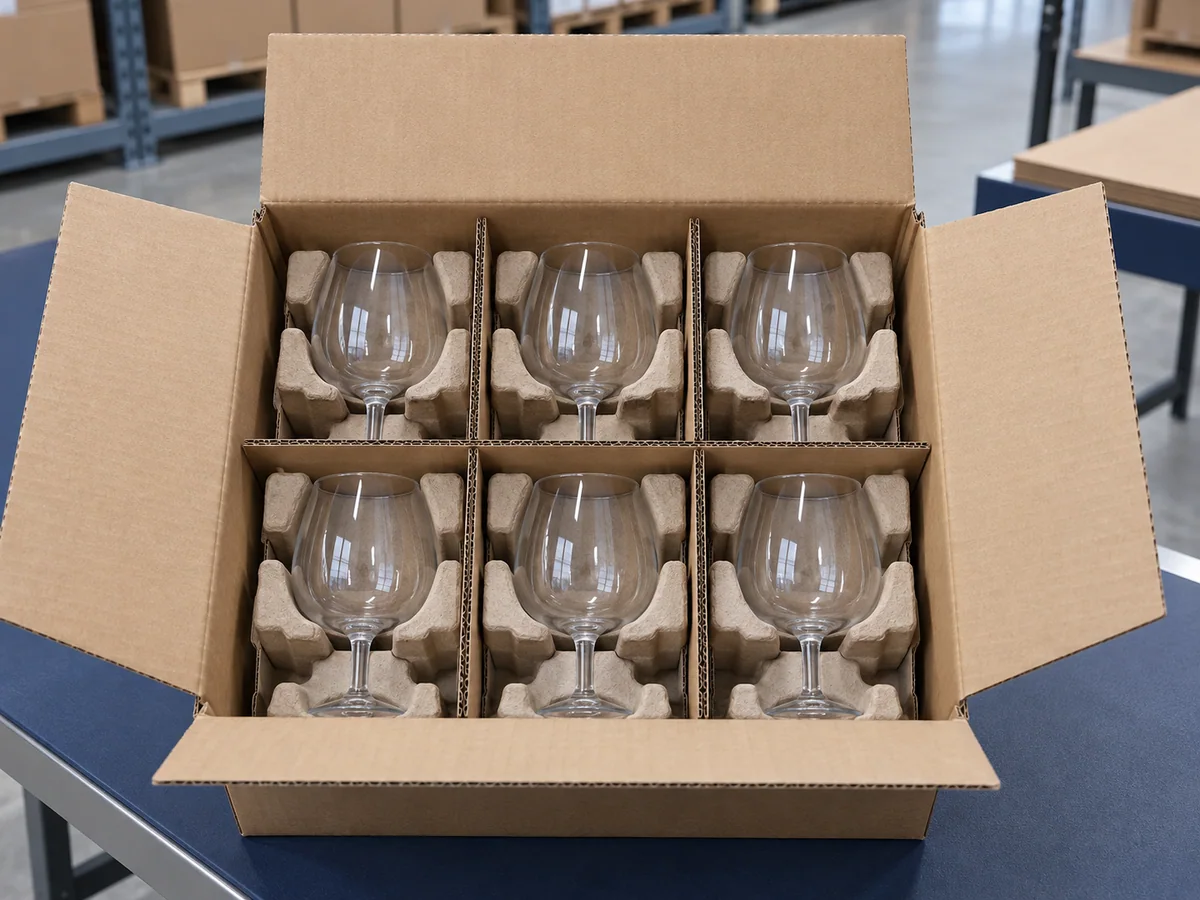
Specify each packaging layer instead of accepting a case count by itself:
- unit or retail pack, including set composition and artwork;
- inner protection around the bowl, stem and foot;
- divider or molded insert material and fit;
- pieces per inner and master carton;
- master-carton external dimensions, net weight and gross weight;
- pallet type, stacking pattern, maximum height and securing method;
- agreed transit-test or packing-validation method.
Do not assume that two capacities using the same bowl family can share an insert or carton. Ask for a packing drawing and review a physically packed sample. Calculate landed cost per sellable unit using the approved carton and pallet configuration, estimated damage handling and replacement terms—not only the quoted unit price.
If the buyer specifies an EPAL Euro pallet, the official EPAL product sheet identifies the EPAL Euro Pallet as 800 × 1200 mm. Other pallet formats also exist, so name the required pallet rather than calling one size universally standard. See the EPAL product sheets.
7. Use an agreed sample-approval plan
Visual inspection should follow written acceptance criteria. Tapping a rim to judge the sound is not a substitute for material identification or performance testing, and one arbitrary number of dishwasher cycles cannot prove lifetime suitability.
For the approved sample:
- Match the product reference, drawing revision and material description.
- Measure capacity using the agreed water method and record temperature or other relevant conditions.
- Check every dimension, unit weight and the agreed tolerance.
- Inspect rim, bowl, bowl-to-stem joint, stem, foot and base stability against agreed visual criteria.
- Test the intended fill and service handling on the buyer’s tray, rack, shelf and table.
- Test the decorated finish and wash routine using an agreed protocol appropriate to the intended use.
- Review the actual unit pack, insert, master carton and packed-sample performance.
- Photograph and sign the approved sample, drawing and any written exceptions.
Keep the approved reference for comparison with production goods. Sample approval does not replace production inspection; agree how production lots will be sampled and what happens when results fall outside the approved specification.
8. Send suppliers a comparable RFQ
Include the same information in every request:
- destination market, channel and intended use;
- wine or beverage types and intended fill volumes;
- selected profile or reference sample;
- dimensioned drawing and proposed tolerances;
- material and forming or strengthening claims to be documented;
- quantity by SKU and expected repeat-order needs;
- decoration artwork and approval process;
- care instructions and destination-relevant supporting documents;
- unit, inner, master-carton and pallet requirements;
- sample scope, production inspection and commercial terms.
Ask suppliers to list exceptions and assumptions beside the corresponding requirement. A fast quotation is useful only when it prices the same finished, packed and documented item.
Explore the Glarivo Wine, Spirits & Gift Sets topic and glass stemware collection, or visit the Glarivo company page to start an inquiry with your profile, fill-volume and packaging brief. Reconfirm product availability, dimensions, material, order quantity, decoration, documents and packing in the final quotation and approved sample.
FAQ
Does a restaurant need separate red- and white-wine glasses?
Not always. The decision depends on the wine list, service positioning, storage, rack capacity and replacement plan. An approved all-purpose profile can reduce SKUs; a distinct red-wine profile may be justified when it supports a clear service objective.
What nominal capacity is needed for a particular pour?
There is no universal multiplier. Put the intended fill into the exact sample and assess the visible level, headspace, bowl geometry and service requirements. Record both the intended fill and measured brimful capacity.
Is “lead-free crystal” a complete material specification?
No. Ask for the supplier’s composition declaration, the market-specific basis for the description and supporting documents relevant to the finished product and destination.
Must commercial wine glasses be tempered for dishwasher use?
Do not make that assumption. Request written care instructions and supporting evidence for the exact glass and wash conditions. Material name or appearance alone does not establish dishwasher suitability.
Should the buyer approve an undecorated or decorated sample?
Approve the version you intend to order. An undecorated blank can confirm shape and dimensions, but it cannot establish artwork position, finished appearance, wash behavior or packing protection for a decorated glass.