Customer case study
"NOVA CLUB" Bar: Custom Glassware from Brief to Delivery
A custom glassware project for "NOVA CLUB" bar covering UV-reactive decoration, sample revisions, a 14,600-piece first order, protective packing and three-month client feedback.
- Pieces in the first order
- 14,600
- Agreed project delivery window
- 35 days
- Breakage recorded on arrival
- ~0.6%
- Client usage follow-up
- 3 months
01 / Project brief
The inquiry: distinctive glassware with practical service requirements
The brand manager of "NOVA CLUB" bar contacted Glarivo through the website on a Friday evening. The existing glasses did little to distinguish the venue, while breakage and decoration wear were recurring operational concerns. The client wanted a recognizable collection that would work with the club's lighting and remain practical for a busy bar team.
We replied the same day and arranged a video call for the following day. The initial discussion focused on the venue's drinks, lighting and washing routine so that the brief covered both appearance and everyday handling.
02 / Service requirements
Defining the range around the menu, lighting and washing routine
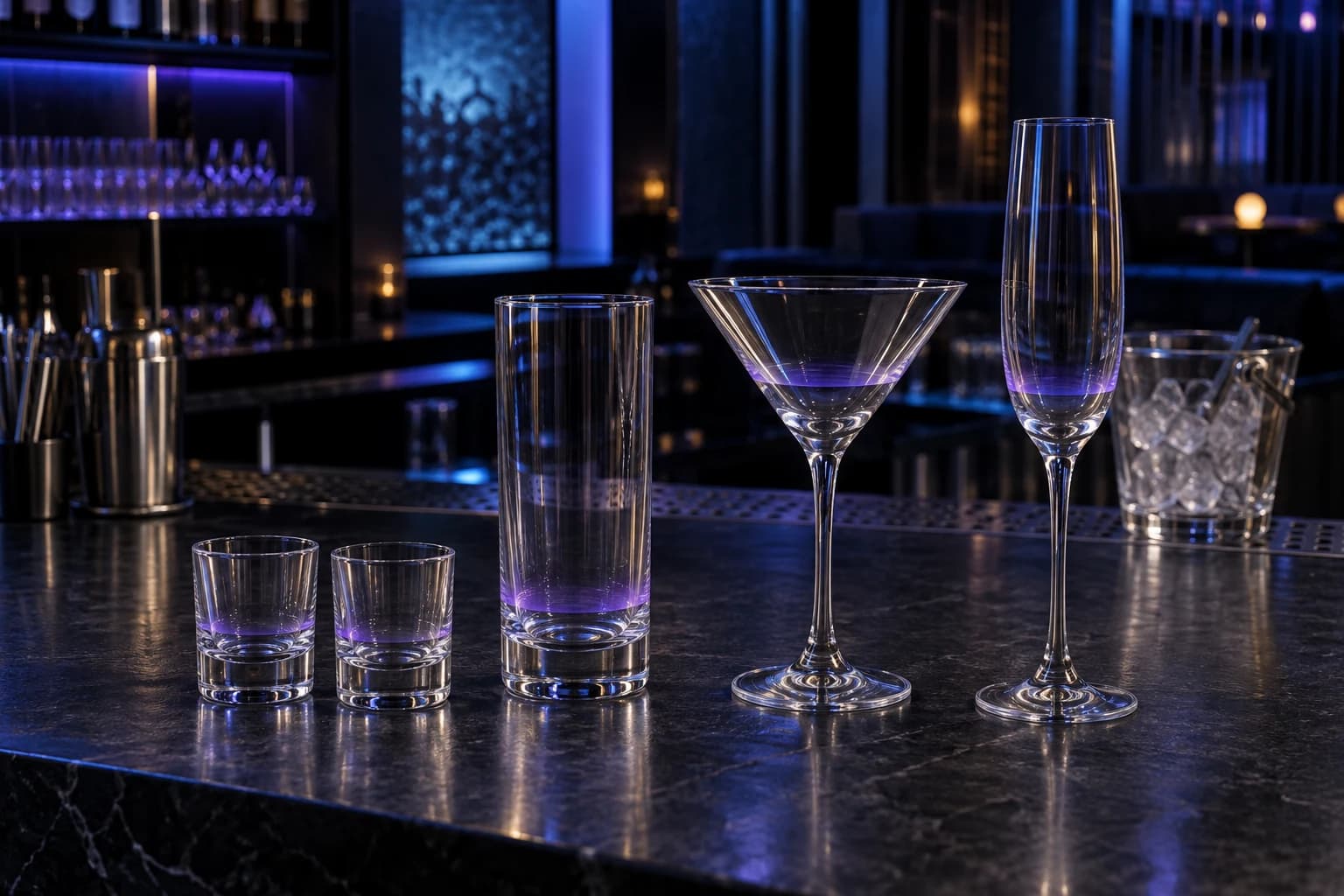
The club owner and bar manager reviewed the balance of shot, cocktail and champagne service, the lighting at the bar, dishwasher use and the preferred position of the brand detail. These decisions established the product shortlist before quotation.
The brief called for high-clarity glass, a substantial base and a smooth, rounded rim. The proposed finish combined printed decoration, selective frosting and a decorative effect reviewed under the venue's UV lighting. Champagne glasses and bar tools were also included in the project scope.
| Product | Specified capacity | Intended setting |
|---|---|---|
| Shot glass | 60 mL | Shot service and UV display shelf |
| Highball glass | 400 mL | Long drinks at the main bar |
| Martini glass | 220 mL | Cocktail service |
| Ice bucket | 5 L | Champagne service area |
03 / Decoration design
Three decoration directions, reviewed in the venue's lighting
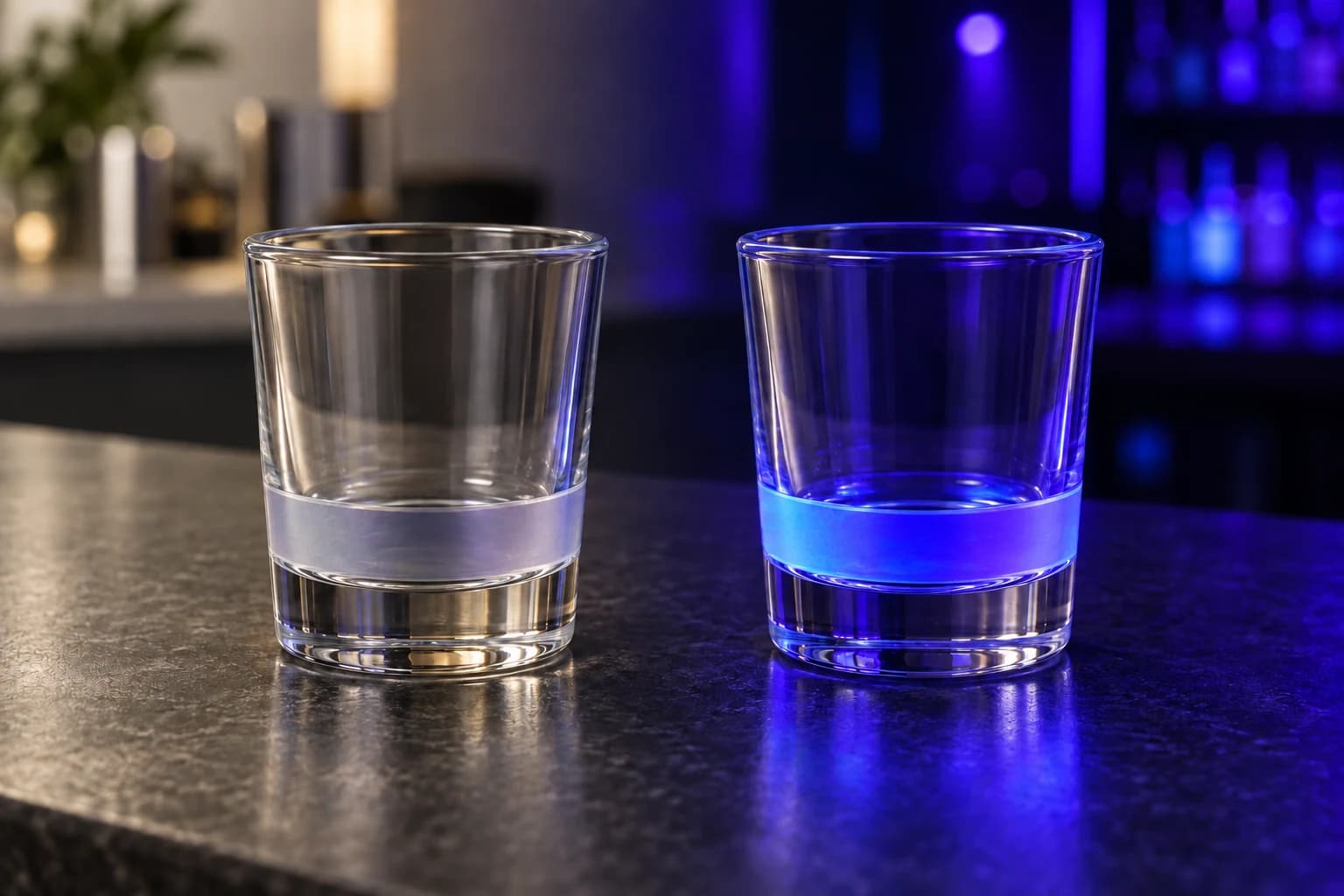
The design stage explored three directions: a restrained frosted logo for champagne glasses, a luminous ring near the base of a shot glass, and a gradient effect on the highball and martini glass bodies. The client selected the gradient direction as the main visual treatment, combined with the venue's wordmark and symbol.
A frosted number on the base supported stock identification. Sample review considered the design in normal light and under UV illumination, where the decoration appeared blue-violet. Reviewing both settings helped the client balance a restrained daytime appearance with a more visible effect during evening service.
04 / Sample revisions
Sample approval: a heavier base and a revised decorative finish
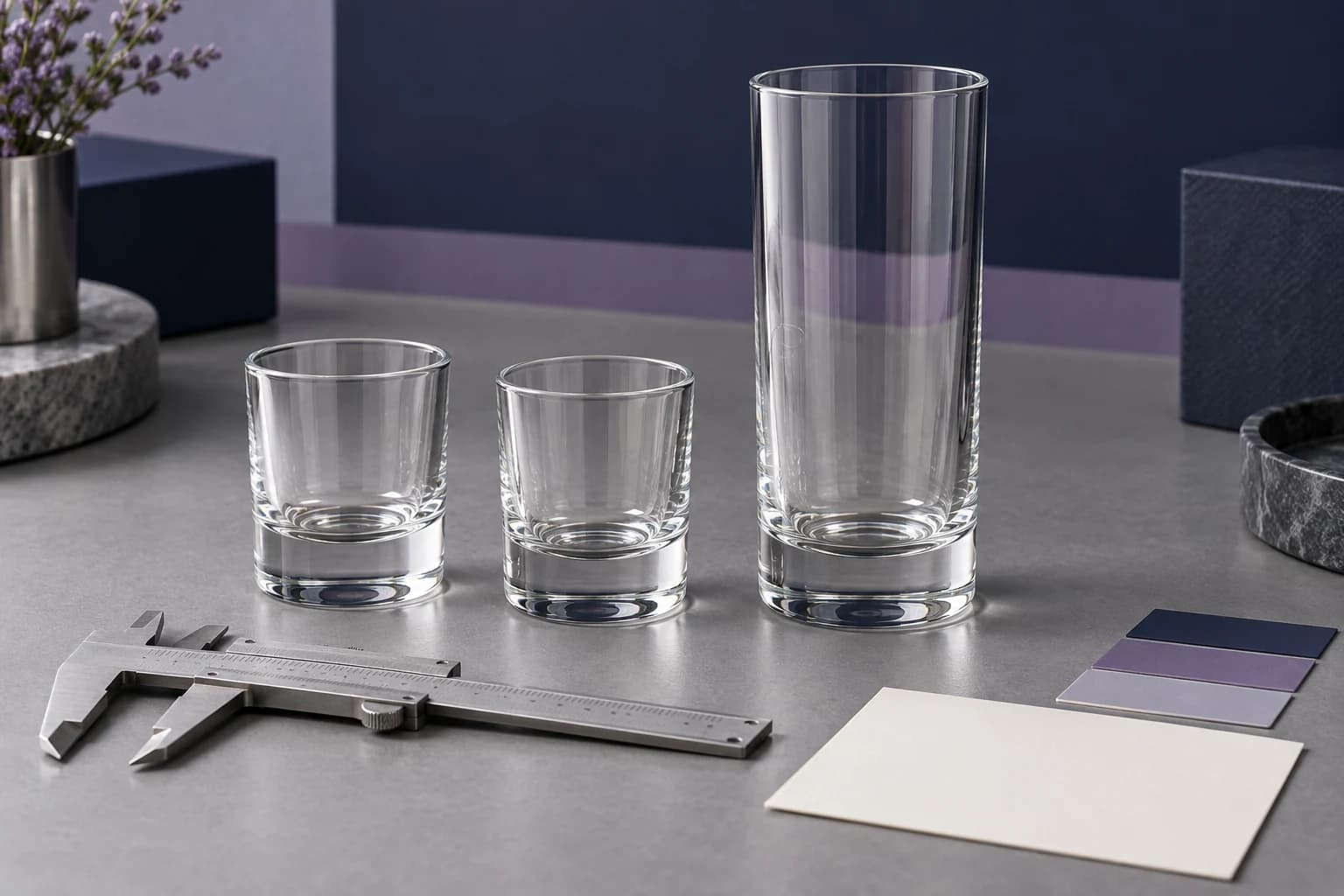
The first samples reached the bar seven days later. The client reviewed them through washing, ice handling, a liquor soak and observation of the decorative effect under UV light. The project account records 20 consecutive dishwasher cycles and a 24-hour soak as part of this sample evaluation.
The bar manager reported that the base felt too light and that the glass was unstable with ice. We increased the base thickness by 1 mm and adjusted the decorative formulation. The second sample was approved for the order.
The sample evaluation was specific to the venue's approval process. The approved second sample became the reference for production, the finished-product care instructions and packing decisions.
05 / Order and schedule
Agreeing the order scope, packing and delivery window
The project quotation used FOB Shenzhen terms, with a 30% deposit and the balance due before shipment. The contract recorded a 35-day delivery window, decoration-adhesion requirements, a breakage replacement provision and the agreed protective packing.
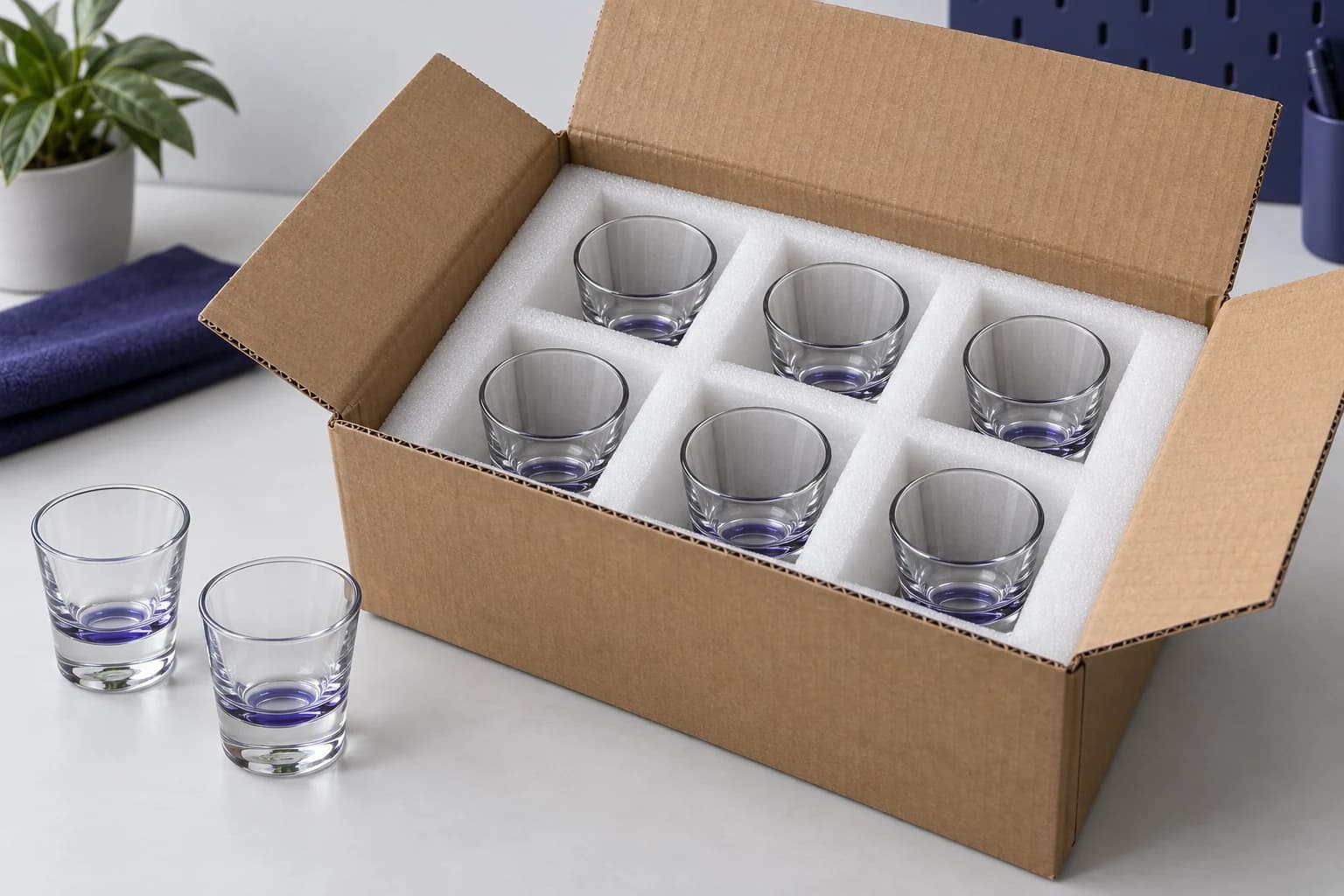
The packing specification called for individual foam cells, five-layer corrugated cartons and custom outer-carton identification. Test documentation was included in the shipment requirements. Once the order was scheduled, the factory reserved the materials and decoration-line capacity.
These were the commercial terms of this order. Quantities, documentation, packing and lead times for a new project require a separate quotation.
06 / Production control
Keeping glass dimensions and decoration aligned during production
The production record follows the glass from incoming material checks through forming and annealing, then through printing, heat treatment, the decorative coating stage and its subsequent curing. The decoration stages were coordinated with the approved sample rather than reviewed only as a final appearance check.
The production record specifies checks every two hours for capacity, rim roundness, base thickness and decoration position. This kept the revised base and approved artwork location in the production review. The decorative layer had its own curing stage within the agreed process.
07 / QC and packing
Final checks and individual packing compartments
Final inspection addressed the specified capacity tolerance of ±3%, rim condition and decoration adhesion. The project record also describes a separate 50-cycle dishwasher simulation during quality control. This is distinct from the earlier 20-cycle client sample evaluation.
The packing used individual foam compartments to separate the glasses, with item identification and fragile-handling marks on the outer cartons. The team reviewed the assembled packing and protection around each glass before shipment.
Glass body
Check capacity, rim condition and the revised base against the approved specification.
Decoration
Review location, visual consistency and the order's adhesion and washing criteria.
Packing
Separate individual glasses and match carton identification to the receiving list.
08 / Delivery
Coordinating transport and the venue's receiving schedule
The order travelled by sea and truck. The packing list, invoice, certificate of origin and required test documents were prepared ahead of dispatch to support the shipment and clearance process.
Three days before arrival, the logistics team arranged the unloading time with the venue to avoid peak bar hours. This made receiving part of the service plan rather than an interruption to the club's busiest period.
09 / Arrival checks
Arrival checks, display setup and staff handover
The arrival record lists 14,600 pieces and 88 broken pieces, equivalent to approximately 0.60% of the shipment. The shipment result is specific to this order and is not a guaranteed breakage allowance for future deliveries.
The bar setup placed shot glasses on the UV display shelf, highball and martini glasses at the main bar, and ice buckets in the champagne area. A 30-minute staff handover covered washing, avoiding inappropriate stacking and presenting the decorative effect under the venue's UV lighting.
| Item | Recorded result |
|---|---|
| Pieces in the shipment | 14,600 |
| Broken pieces recorded on arrival | 88 |
| Calculated arrival breakage | 88 ÷ 14,600 × 100 ≈ 0.60% |
| Staff handover | 30 minutes |
10 / Client feedback
Three-month feedback and a repeat order
At the three-month follow-up, the bar manager reported that the weighted base felt stable, the logo remained in place through the venue's washing routine, and guests had asked whether the glasses could be purchased. The UV display had also become a feature guests photographed.
At the three-month follow-up, the client reported a monthly breakage rate of 1.2%, compared with approximately 8% previously. This was a venue-reported operational result following the change in glassware and handling routines, rather than an independently controlled product comparison.
The client subsequently reordered champagne glasses, ice buckets and bar tools, and discussed gift-box options for takeaway sales. The repeat order extended the original brief from a visual refresh into ongoing purchasing and replenishment.
Plan your glassware project with Glarivo
This project connected the nightclub's visual brief with sample feedback, production checks, protective packing and staff handover. The key revision was practical as well as visual: the base was adjusted after the bar team's sample review. For a similar project, share your drink menu, glass references, lighting, washing routine, quantities and required arrival date so we can discuss an appropriate sample and packing scope.